

Shin Godzilla turns 10 years old this year. How does it hold up as part of a prolific franchise?
Without even planning it, I am watching Shin Godzilla for the first time almost exactly 10 years after its release in 2016. This review contains my honest thoughts and takeaways from this installment in the Godzilla franchise. Overall, I think Shin Godzilla is a wonderful addition to the franchise and thoughtfully speaks to many of the themes characteristic of its origins. It also contains a distinct Japanese flavor which Japanophiles will love just as much as Godzilla himself. Despite this solid plot and setting, the movie’s use of CGI left something to be desired, especially in the first half of the film.
Shin Godzilla was conceived at an interesting time in the history of the Godzilla franchise. First conceived in 2014, it was developed as a new Japanese reboot of the franchise not long after American studio Legendary Pictures released its own Godzilla reboot in 2014. Before this, Godzilla had not seen any new theatrical releases since TriStar Pictures’ 1998 Godzilla and Toho’s 2004 Godzilla: Final Wars. So, the 2014 Legendary Pictures release, along with Shin Godzilla only two years later, left fans with two new, well-crafted additions to the Godzilla universe.
Shin Godzilla also draws on themes specific to life in Japan, specifically around the early 2010s. During its release in 2016, the country was only a few years removed from the 2011 disaster at the Fukushima Daiichi nuclear plant, which reignited policy debates and issues over nuclear power and weapons (more on that later). In addition, this film wholeheartedly critiques and even satirizes aspects of Japanese bureaucracy and workplace culture. It may even be reasonable to call this a film about the woes of Japanese bureaucracy that happens to feature a monster, rather than a monster movie that happens to take place in Japan.
The sheer ridiculousness of the first minutes of the movie when the Japanese government is trying to understand their unprecedented situation, yet still follows rigid bureaucratic procedures and decorum, was hilarious. One of my favorite lines of the whole movie was, “Frankly, we’re not yet sure what agency this situation falls under.” I found this to be a very interesting take on Godzilla: The necessity to coordinate and communicate within a bureaucracy in order to manage an unexpected disaster. It’s not something that’s been done with Godzilla before, but its inclusion as one of the main themes of Shin Godzilla is entirely understandable given the national emergencies and disasters Japan had to deal with in 2011.
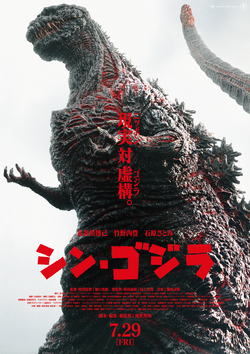
As for the monster himself, I had mixed feelings about this film’s depiction of Godzilla. Most viewers will probably agree with me when I say the audience’s first glimpse of Godzilla’s full body is utterly terrifying and ridiculous at the same time. In Shin Godzilla, the monster emerges from the sea in a half-evolved form boasting huge gills, lacking arms, and a laughably horrendous, computer-generated face. It pushes itself along the ground through Tokyo’s streets, and in doing so pushes hundreds of equally badly-generated cars in ways that seem physically impossible. Although the sheer ridiculousness of this computer-generated monster and destruction made me giggle, I felt that it took away from the supposed terror and alarm of the situation. Only when Godzilla evolved into a more advanced form, and its model was replaced with something more akin to a puppet, did the film’s antagonist actually appear dangerous and threatening.
Although I didn’t love the use of CGI in Shin Godzilla, I did love the cinematography. The film uses a documentarian style in many of its shots that helped to make the plot feel more real. The use of camera shake and close-ups reinforces a sense of urgency throughout the film, especially during shots of the Japanese bureaucrats scrambling to make decisions and come up with solutions. I especially enjoyed the scenes of the bureaucracy-hating, ad hoc response team headed by main character Yaguchi. The cinematic choices used to depict this team functioned well to reinforce this group’s chaotic yet effective dynamic and desire to communicate and collaborate by breaking down bureaucratic divides. Despite the film’s CGI which, in my opinion, does not hold up well ten years later, I thought it more than made up for itself through its variety of cinematic shots and effective filming techniques.
I really started to love this movie during Godzilla’s climactic “power-up” scene and subsequent tonal shift in its plot. I thought the combination of classical opera and Godzilla’s glowing power-up sequence was very effective at mentally and physically preparing the viewer for the next moments in this scene. Once Godzilla debuts its fire breath and concentrated purple energy beam that consumes and destroys large swaths of Tokyo, my view of the monster immediately shifted. After Godzilla unleashes its full power, the futility of the situation comes to the forefront of the plot and an overwhelming sense of doom takes over. I thought this was a great allegory to the use of nuclear weapons and its immediate aftermath: fire, deadly radiation, and the sense that nothing can stop them.
My favorite part of the plot concerns the themes brought up after Godzilla’s attack on Tokyo. After Godzilla withstands heavy bombardment by American bombers and destroys parts of Tokyo, it’s clear to everyone involved that defeating Godzilla will take extreme measures. The plot becomes decidedly darker then, as the United States decides to take over the response and pursues the use of nuclear weapons to neutralize Godzilla. Not only does this mean that Japan gets booted from leading its own disaster response, it also means that the same country which dropped atomic bombs on its cities decades earlier is now considering doing the exact same thing. To the Japanese characters, this possibility is unthinkable and unconscionable. Members of the Japanese cabinet openly lament American involvement, with one character even labeling themselves as “vassals” under the new American-led response. To the Japanese, it seems as though using a nuclear weapon on Godzilla is a worse option than to just let Godzilla continue destroying Tokyo. Undoubtedly my favorite line in the film comes from this back-and-forth existential discussion about using nuclear weapons: “Man is more frightening than Godzilla.”
Coming off a recent trip to Japan myself, I loved the overall “Japaneseness” of Shin Godzilla. Aside from the bureaucratic satire, the film’s setting in Tokyo and features of different wards and neighborhoods in the metro area, complete with explicit on-screen names and locations, really emphasizes this film as one of Japanese origin and creation. Despite Toho being the owner of the Godzilla IP in Japan for decades, they’ve still been able to keep the franchise fresh while maintaining a focus on home. I especially liked the use of Japanese infrastructure to ultimately defeat Godzilla. The sequence combining the felling of buildings on Godzilla, using concrete trucks to pump him full of blood coagulant, and even using bullet trains to trip him up really put the cherry on top in terms of feeling like the film used a solution that only the Japanese would come up with.
Overall, I’m a fan of Shin Godzilla. I will also admit… I’ve already watched it a second time only a few days after watching it for the first time. And something even crazier? I’m getting used to the crazed CGI Godzilla with huge gills and no arms. The film clearly has good rewatchability, with a satirized glimpse into Japanese life while also providing a fresh and entertaining take on a decades-old monster and Japanese classic. Even then, Toho has managed to stay true to Godzilla’s origins and themes. Godzilla was born in 1954 out of the radiation and waste generated from testing nuclear bombs. Today, Godzilla remains a solid allegory to the nuclear issues that continue to shape our society.