
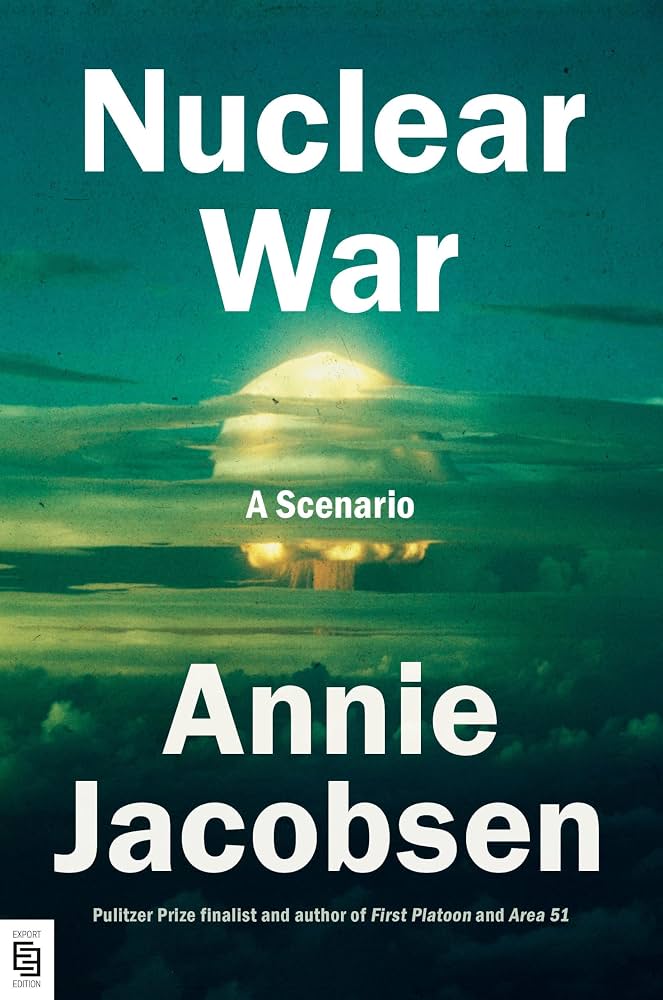
Annie Jacobsen is a Pulitzer Prize-nominated journalist with accomplished popular reads such as Area 51 and Operation Paperclip. I have not yet had the pleasure of reading Jacobsen’s other works, but will certainly be doing so after reading her newest book, Nuclear War: A Scenario. This book is Jacobsen’s attempt at compiling declassified documents, interviews, and other sources into a comprehensive yet enthralling telling of what could happen to the United States – and the entire world – if nuclear deterrence fails and war ignites via the exchange of nuclear weapons.
A feature of this book that I immediately liked was Jacobsen’s inclusion of a list of every person she interviewed for the book and their job title/area of expertise. Her interviews include military officers, intelligence experts, nuclear scientists, weapons engineers, Cold War historians, and many more. Providing this list at the beginning of the book was a wise move to immediately establish credibility.
Jacobsen partitioned her book into four parts which worked to break up the fast-paced content of the book and gave the reader a good expectation for how the book progresses. Part one covers the first 24 minutes between the launching of a nuclear weapon and its arrival at its ultimate target. This part seemed to be the most well-researched and thought out, as Jacobsen explains this scenario has been modeled and rehearsed for decades by the United States military.
Part two of Jacobsen’s book covers the next 24 minutes after a nuclear weapon strikes the United States and its immediate domestic and geopolitical effects. This part is based more on conjecture, which leaves the scenario in the book lacking a bit of realism, or at least sound logic. In the book’s scenario, North Korea is the main instigator of nuclear war by launching a nuclear weapon at the United States. Okay – that’s an understandable scenario and, as Jacobsen spells out, very possible. However, part two of the book explores the immediate geopolitical ramifications of this act, including American retaliation by launching their own arsenal of nuclear weapons at North Korea and this decision’s chilling side effect on its nuclear-armed neighbor, Russia.
My main criticism of Jacobsen’s book, and in particular the scenario presented in Nuclear War, is the eventual decision of Russia to launch nuclear weapons at the United States. In the book’s scenario, the retaliatory nuclear weapons launched at North Korea by the United States appears on Russian missile sensors as being destined for Russian soil, not North Korean. This ultimately influences the Russian president to preemptively launch nuclear weapons at the United States. Now, a point that Jacobsen makes in the book is that there is very little time to act and make decisions when faced with imminent nuclear destruction. The Russians believe they are being targeted by America, despite knowing they themselves did not launch the first weapon. Jacobsen also plainly spells out in the book that the Russians know that America has superior missile sensor technology, and would know that Russia was not the instigator of this theoretical nuclear war. So why, despite this information presented to the reader, does Russia decide to launch nuclear weapons at the United States? Logically, it does not make sense and sours this part of Jacobsen’s nuclear war scenario.
The last part of Jacobsen’s Nuclear War dives into the theoretical realm of a post-nuclear earth. I was not expecting the inclusion of this apocalyptic speculation when I first got my hands on the book, but I’m glad that Jacobsen made the decision to write about it. What happens after nuclear war has long been the subject of debate, speculation, and even fantasy, but Jacobsen brings a thoughtful and well-researched eye to what may happen to life and the planet after a civilization-ending nuclear exchange. I particularly liked the elaboration on the concept of nuclear winter and its short and long-term impacts on earth’s ecosystem.
Jacobsen wraps up her morbid telling of nuclear apocalypse by speculating on what earth may look like even 24,000 years after nuclear war, when the planet has somewhat recovered and life thrives once again. These last few paragraphs of Jacobsen’s book is oddly optimistic and, to an extent, self-blaming; maintaining that our planet has gone through extraordinarily catastrophic events before and will probably come out of human-induced nuclear war just fine in the long run. After providing excruciating detail on nuclear fireballs, radiation sickness, death tolls, and other morbid estimates, Jacobsen leaves the reader with a simple yet understandable thought about nuclear war: Would we deserve it?
Now that I’ve read some Annie Jacobsen, I plan to read her other popular works Area 51 and Operation Paperclip. Not only am I looking forward to another thorough yet to-the-point read by Jacobsen, I’m also interested to learn of Jacobsen’s research behind these two atomic age-adjacent topics. In Nuclear War: A Scenario, Jacobsen has proven she can speculate on, and even confirm, certain details about nuclear war that may have been buried or even unknown knowledge since the early days of the Cold War. Jacobsen has an uncanny ability, like other investigative journalists, to dig up obscure yet fascinating facts about theoretical nuclear exchange that could spell the end of the world as we know it… and make the reader want to read every last word.
This review may be updated as needed.