

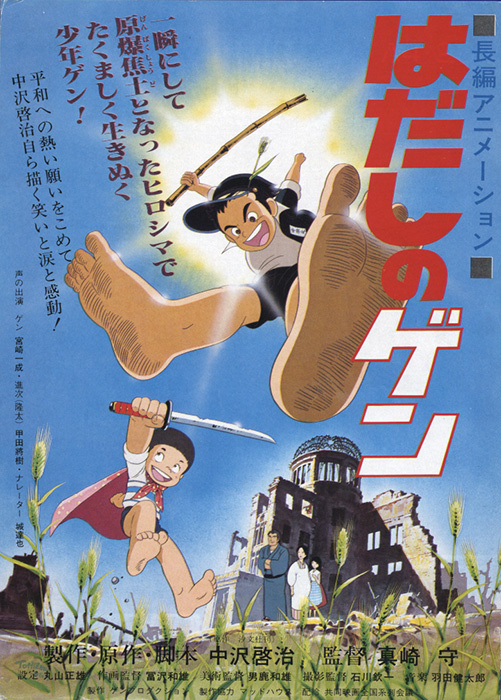
Today marks 81 years since the atomic bombing of Hiroshima. Barefoot Gen tells us the story through a child’s eyes.
Barefoot Gen is a 1983 anime film directed by Mori Masaki and based on Keiji Nakazara’s manga of the same name. The film explores main character Gen’s experience surviving the atomic bombing of Hiroshima and its immediate aftermath. Although an anime (cartoon) whose main character and plot revolve around children and youth, Barefoot Gen doesn’t shy away from the violence, trauma, and plain horror of the events of that day and months afterward. However, the film also demonstrates the resilience and perseverance needed by the bomb’s survivors to carry on and keep living.
In the early minutes of the film, we see Gen and his family going about their daily routines while dealing with the challenges of wartime at home. I was pleasantly surprised at the honesty with which the film explains the unfortunate situation that Hiroshimans found themselves in by this point in the war. Despite being spared thus far from American bomber attacks, there is obvious suffering going on in Hiroshima. Malnutrition affects Gen’s family, and Gen’s father, Daikichi, places the blame for Japan’s situation squarely on their own government. Japan tends to have a reputation of shying away from discussing wartime actions that may place blame on its own people or government. In Barefoot Gen, it was interesting seeing this reputation tested and learning that yes, some Japanese media does address taboo issues like Japan’s responsibility in the war.
It shouldn’t be a surprise that the tone of the movie shifts dramatically as soon as the bomb is dropped and explodes. However, what really shocked me was the level of horrifically true-to-life detail included in the film depicting the immediate effects of the attack. I recently read John Hersey’s Hiroshima, in which he retells the experiences of survivors. I noticed that several of those details were incorporated into Barefoot Gen, including the “melting” of people directly exposed to the blast, the fires that started and swept through the ruined city, the half-dead survivors finding and drowning in rivers, and the innumerable scarred residents clinging to life in nearby woods and parks. The bombing of Hiroshima was truly a horrifying event, which Barefoot Gen manages to capture and illustrate exceptionally well.
Despite the tragedy of the situation, Barefoot Gen is really a story of resilience and perseverance. Within the first minutes of the bombing, Gen is tasked by his father to take care of his mother and her baby while also watching the rest of his family burn to death. It’s a situation that is unfathomable to most people living today; most of us simply have not lived in a time in which this level of death and destruction has been a legitimate concern. But to the survivors of Hiroshima, this was a catastrophic emergency that required strict discipline and responsibility if one was to survive its effects. Once Gen’s baby sister is born shortly after the blast, the characters concern themselves with the wellbeing of the infant rather than their own safety and preservation. Despite having to navigate a ruined, contaminated city – as well as his own potential demise due to radiation sickness – Gen does not hesitate to take on the responsibility of caregiver and provider for his newborn sister. Throughout the film, Barefoot Gen goes beyond a simple disaster movie and excels in portraying its characters as vulnerable yet resilient.
Although an animated film, Barefoot Gen stands apart as a true-to-life interpretation of the atomic bombing of Hiroshima. Many Americans, especially those not familiar with Japanese anime, would readily assume that Barefoot Gen is a children’s movie and would be easily confused as to why this content would be shared with children. Instead, I think it’s important to understand that as Japan has rebuilt itself after war, different methods and platforms have developed for the Japanese to unpack and process its collective trauma. With Barefoot Gen, tragic and heartbreaking events have been packaged in a traditionally child-centered medium for an adult audience. I really think this was the best way to deliver the plot of Barefoot Gen: a child’s perspective of the Hiroshima bombing packaged in an artform made primarily for children.